
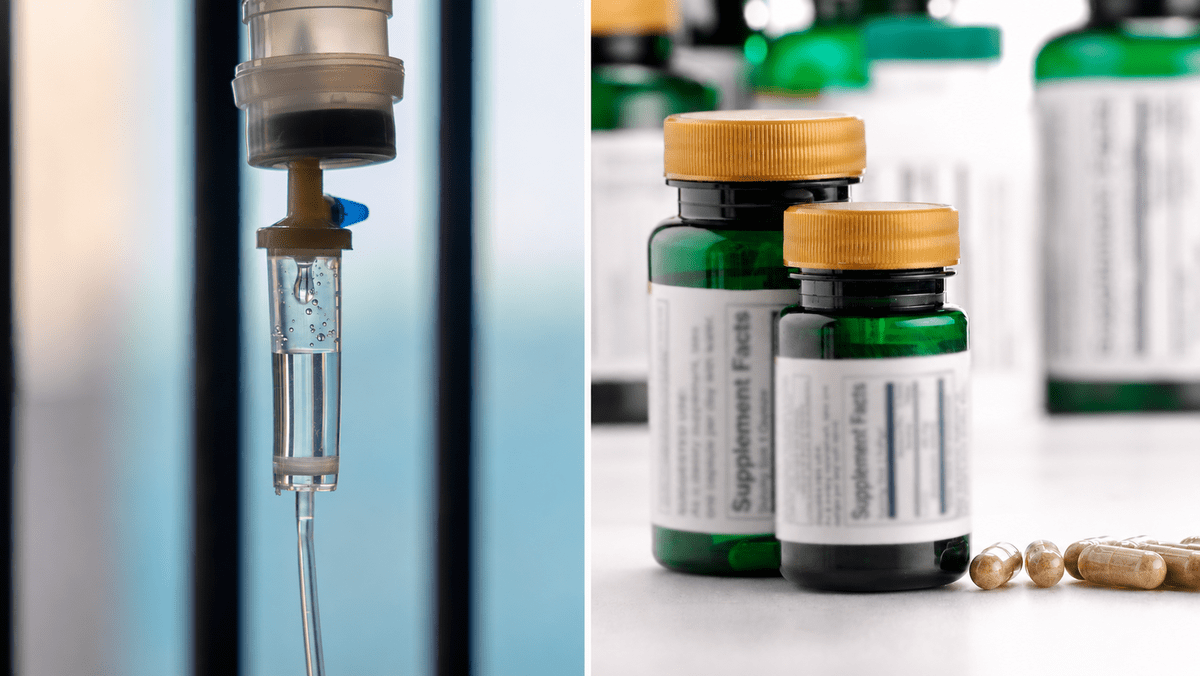
NAD IV Therapy vs. NAD Supplements: What Is the Actual Difference?
- Amani Health & Wellness
- June 7, 2026
- 10 min read
NAD IV therapy
Table of Contents
If you have been researching ways to boost your NAD levels, you have probably come across two main options: NAD IV therapy and oral NAD supplements. Both claim to restore cellular energy, sharpen mental clarity, and support healthy aging. But they are not the same thing, and the difference between them is not just a matter of convenience or price. It comes down to how your body actually absorbs and uses NAD depending on how it is delivered.
This article breaks down exactly how NAD IV therapy and oral supplements differ, what the science says about each, and how to think about which approach fits your situation. For a full overview of the IV therapy options available, visit the IV Hydration and Injections page.
1. What NAD Actually Is and Why It Matters
NAD, or nicotinamide adenine dinucleotide, is a coenzyme present in every living cell in the human body. It plays a central role in several critical biological processes:
- Converting nutrients into cellular energy through the mitochondria
- Supporting DNA repair mechanisms that protect cells from damage
- Regulating proteins involved in aging and inflammation
- Maintaining efficient communication between cells
The challenge is that NAD levels decline naturally with age. According to research published by the National Institutes of Health, NAD concentrations in human tissue can drop by as much as 50 percent between early adulthood and middle age. This decline is linked to reduced energy output, slower cellular repair, and increased susceptibility to the effects of stress and aging.
When NAD levels fall significantly, the effects are noticeable. Persistent fatigue that does not improve with rest, difficulty concentrating, slower physical recovery after exercise, and a general sense of running below capacity are all common signs of depletion. Restoring NAD levels is the goal of both IV therapy and oral supplementation. The difference lies entirely in how effectively each method achieves that goal.
2. How NAD IV Therapy Works in the Body
NAD IV therapy delivers nicotinamide adenine dinucleotide directly into the bloodstream through an intravenous infusion. Because the NAD bypasses the digestive system entirely, the body receives and can begin using it almost immediately.
The process works as follows:
- A licensed provider places a small IV catheter, typically in the arm
- A measured dose of NAD is administered through a saline solution over a period of 1.5 to 3 hours, depending on the dose and the patient’s tolerance
- The NAD enters the bloodstream directly and becomes available to cells throughout the body
- No digestive breakdown occurs, which means absorption is near complete
The infusion rate matters significantly with NAD IV therapy. It is administered slowly by design. Faster infusion rates are associated with temporary side effects including mild nausea, chest tightness, and tingling, which resolve when the rate is reduced. A trained provider monitors the session throughout and adjusts as needed to keep the patient comfortable.
According to a pilot study published in PubMed Central, intravenous NAD administration produced measurable increases in plasma NAD levels and associated metabolites, with no significant adverse events observed in the study cohort.
3. How Oral NAD Supplements Work
Oral NAD supplements come in several forms, including capsules, tablets, sublingual strips, and powders. Most products on the market do not actually contain NAD directly. Instead, they contain NAD precursors, which are compounds the body can theoretically convert into NAD. The most common are:
- Nicotinamide Riboside (NR) — a form of vitamin B3 that the body converts into NAD through a multi-step process
- Nicotinamide Mononucleotide (NMN) — another precursor that enters the NAD biosynthesis pathway at a different stage
- Niacin — the original NAD precursor, less commonly used in modern supplements due to side effects at higher doses
Some products do market direct NAD+ in oral form, but this is where the absorption issue becomes significant. NAD is a large, unstable molecule. According to the Cleveland Clinic, NAD is difficult for the body to absorb in supplement form, and a meaningful portion is broken down during digestion before it can reach the bloodstream at useful concentrations.
Precursor supplements like NR and NMN have more clinical support for oral bioavailability than direct NAD products, but even these follow an indirect route. The body must first absorb the precursor, then run it through a conversion process before usable NAD is produced. How efficiently that conversion happens varies from person to person based on age, gut health, and metabolic function.
4. NAD IV Therapy vs. NAD Supplements: A Direct Comparison
This is where NAD IV therapy and oral supplements diverge most clearly. The core distinction is bioavailability — how much of what you take actually reaches your cells in a usable form.
Absorption and Bioavailability
NAD IV therapy achieves near-complete absorption because it bypasses the digestive system entirely. What is administered goes directly into the bloodstream. Oral supplements, even the most bioavailable precursor forms, must survive the digestive process before entering circulation. According to research published in PubMed Central, nutrients delivered intravenously retain full potency and allow for significantly higher therapeutic concentrations in plasma compared to oral intake.
Speed of Effect
Many patients report noticing changes in mental clarity and energy levels during or shortly after a session. Oral supplements typically require consistent daily use over two to four weeks before measurable changes in NAD levels are detectable in the bloodstream.
Dosing Precision
IV therapy allows for precise, controlled dosing. A provider determines the exact amount based on the patient’s health profile and goals, and that dose is delivered with complete reliability. Oral supplement dosing is approximate. Absorption varies between individuals, and the same dose may produce significantly different plasma levels in different people.
Duration of Session
An NAD IV session requires a time commitment of one and a half to three hours in a clinical setting. Oral supplements are taken in seconds at home. This is a practical consideration that genuinely matters for some people.
Cost
IV therapy is a higher per-session investment than oral supplements. A bottle of NR or NMN costs considerably less than a single infusion. For people managing a long-term NAD protocol, cost and frequency are real factors in the decision.
Clinical Use Cases
IV therapy is the delivery method used in clinical settings for situations requiring significant, measurable NAD restoration, including burnout recovery, athletic performance protocols, and addiction recovery support. Oral supplements are more commonly used for general wellness maintenance and long-term prevention.
5. Who Gets More Out of Each Option
Neither option is universally better. The right choice depends on what the person is trying to achieve and where their NAD levels currently stand.
NAD IV therapy tends to be the stronger fit for people who:
- Are experiencing significant symptoms of NAD depletion such as chronic fatigue, persistent brain fog, or notably slow physical recovery
- Have tried oral NAD supplements without experiencing meaningful improvement
- Are supporting recovery from burnout, intense athletic training, or a demanding period of sustained stress
- Want measurable, relatively fast results rather than gradual long-term maintenance
- Are working with a provider on a structured wellness or recovery protocol
Oral NAD supplements tend to be a reasonable fit for people who:
- Have generally healthy NAD levels and are focused on long-term maintenance and prevention
- Prefer a daily home-based routine without the time and cost commitment of IV sessions
- Are newer to NAD supplementation and want to assess their response before considering other options
- Are looking for a lower-cost ongoing strategy to support cellular health over time
It is also worth noting that for some people, the two approaches are complementary rather than competing. An initial series of sessions can restore depleted levels significantly, after which an oral maintenance protocol may be sufficient to sustain them.
To learn more about what sessions involve and what to realistically expect, read Is NAD IV Therapy Worth It? What to Realistically Expect.
6. Frequently Asked Questions
Yes. The two approaches are not mutually exclusive. Some people use IV therapy to restore significantly depleted levels quickly, then transition to oral supplementation as a maintenance strategy. If you are considering combining them, discuss the timing and dosing with your provider to avoid redundancy.
There is no single universal symptom that confirms low NAD, but common signs include persistent fatigue that does not improve with adequate sleep, difficulty concentrating or maintaining mental clarity, slow recovery after physical exertion, and a general sense of reduced resilience under stress. Some providers offer NAD level testing, which can provide a clearer baseline before starting any supplementation protocol.
NAD precursors like NR and NMN are generally considered safe and well-tolerated at standard doses. Some people experience mild flushing, digestive discomfort, or headache, particularly with niacin-based products. Direct oral NAD supplements have less clinical research behind them, and the bioavailability questions around them remain unsettled. As with any supplement, disclosing use to a healthcare provider is advisable, especially if you take other medications.
This depends on the individual’s goals and starting point. People addressing significant depletion or supporting recovery from burnout typically begin with a series of sessions scheduled closely together, often three to five sessions over two to four weeks, followed by a maintenance schedule spaced further apart. To understand frequency in more detail, read How Often Should You Get a NAD+ Drip for Best Results?
Yes. The specific compound in the supplement affects how it is processed by the body. NR and NMN are the most studied precursors and have the most clinical support for raising blood NAD levels. Direct oral NAD+ products face significant bioavailability challenges due to the molecule’s instability during digestion. If oral supplementation is the chosen approach, the form of the product is worth researching carefully rather than assuming all NAD supplements work the same way.
7. Where the Science and the Decision Meet
Understanding the difference between NAD IV therapy and oral NAD supplements comes down to one central question: how much NAD does your body actually need right now, and how efficiently does it need to get there? If you are managing gradual long-term maintenance and your levels are reasonably stable, oral precursor supplements offer a practical and accessible starting point. If you are dealing with significant depletion, want measurable and relatively fast restoration, or have already tried oral supplements without results, NAD IV therapy delivers a level of bioavailability and dosing precision that oral intake cannot replicate.
The science supports both approaches in their appropriate contexts. The decision is not about which option is superior in the abstract. It is about matching the delivery method to the actual need. For people in the earlier stages of exploring NAD support, starting with oral precursors and assessing the response is a reasonable first step. For people whose symptoms suggest more significant depletion or who have specific recovery goals, IV therapy represents the clinically grounded path forward.
To explore NAD IV therapy in more detail and learn what a session involves, visit the NAD IV Therapy in Mansfield, TX page.
Key Takeaways
- NAD is a coenzyme essential for cellular energy, DNA repair, and healthy aging, with levels declining significantly after early adulthood
- IV delivery bypasses the digestive system entirely, achieving near-complete absorption directly into the bloodstream
- Oral supplements use precursor compounds such as NR and NMN that the body must convert into usable NAD, with results varying by individual
- IV therapy produces faster and more measurable results; oral supplements offer a lower-cost, home-based maintenance option
- The two approaches can work together — IV therapy to restore depleted levels, oral supplementation to maintain them
- People with significant depletion symptoms or no response to oral supplements are typically better candidates for IV therapy
- Matching the delivery method to the actual level of need is what determines the right choice, not one option being universally superior
HAVE QUESTIONS ABOUT NAD IV THERAPY?
Understanding which approach is right for your situation starts with knowing your options. Speaking with a qualified provider can help clarify whether IV therapy, oral supplementation, or a combination of both makes the most sense for your health goals.
Disclaimer: This article is intended for educational purposes only and does not constitute medical advice. NAD IV therapy and supplementation should be discussed with a licensed healthcare provider before starting any protocol, particularly for individuals with existing health conditions or those taking medications.
- Grant, R. et al. (2019). A Pilot Study Investigating Changes in the Human Plasma and Urine NAD+ Metabolome During a 6 Hour Intravenous Infusion of NAD+. PubMed Central. https://pmc.ncbi.nlm.nih.gov/articles/PMC6751327/
- Cleveland Clinic. (2026). NAD+ Supplements: Can They Really Slow Down Aging? https://health.clevelandclinic.org/nad-supplement
- Carr, A.C. et al. (2025). To IV or Not to IV: The Science Behind Intravenous Vitamin Therapy. PubMed Central. https://pmc.ncbi.nlm.nih.gov/articles/PMC12182718/